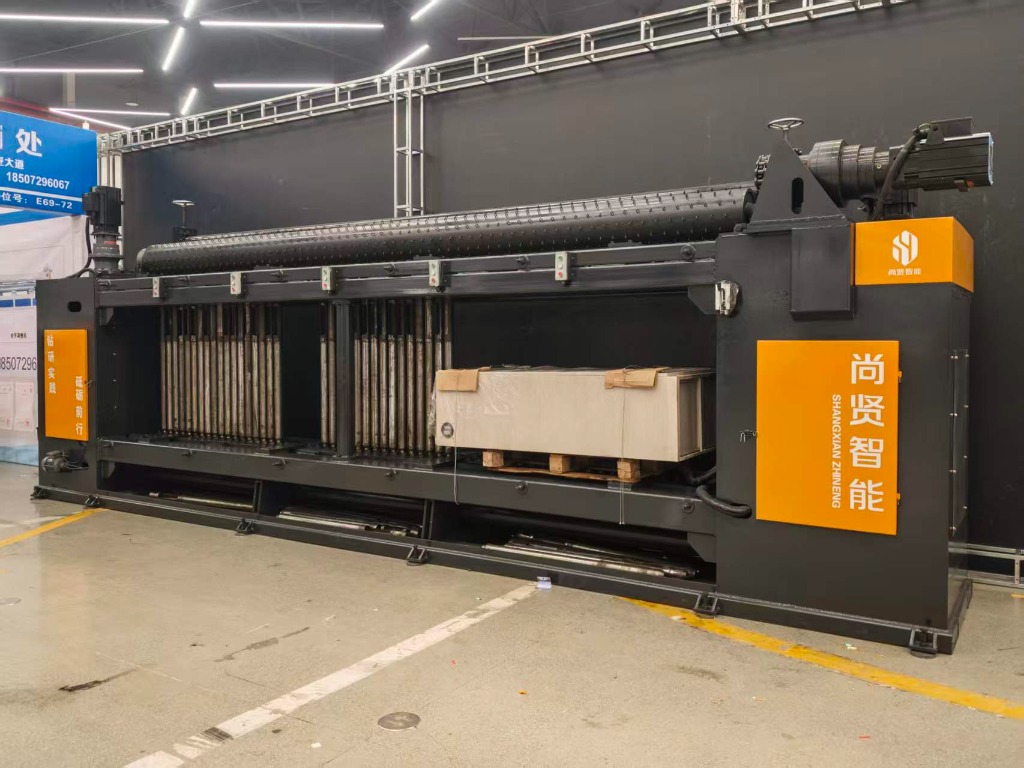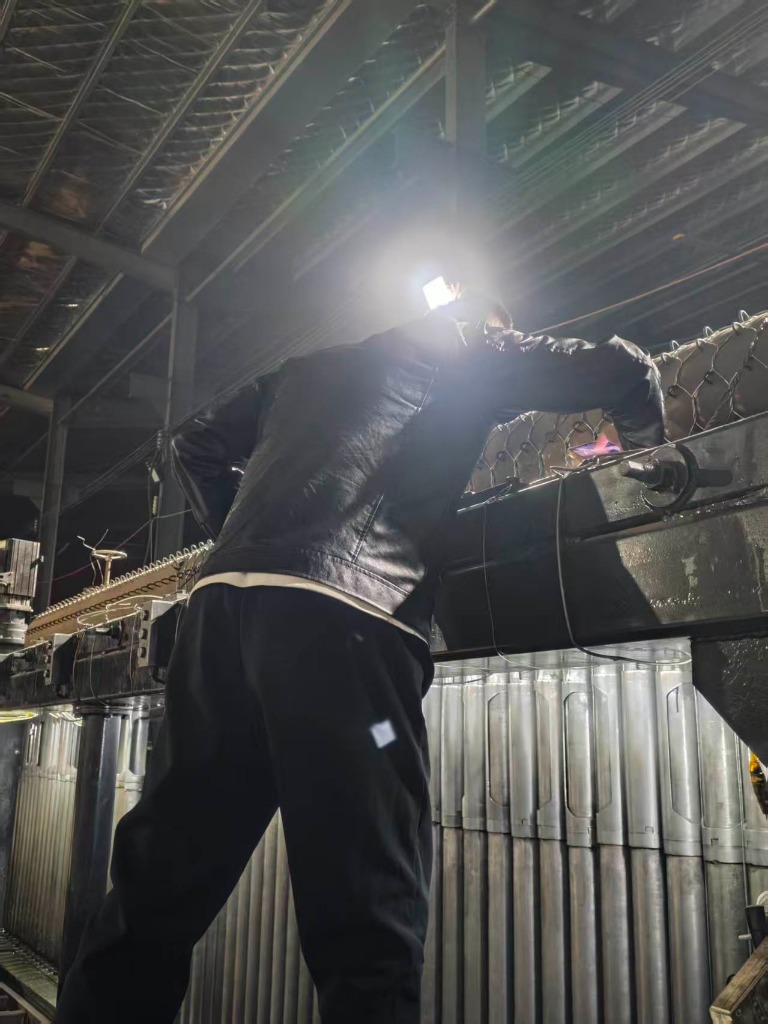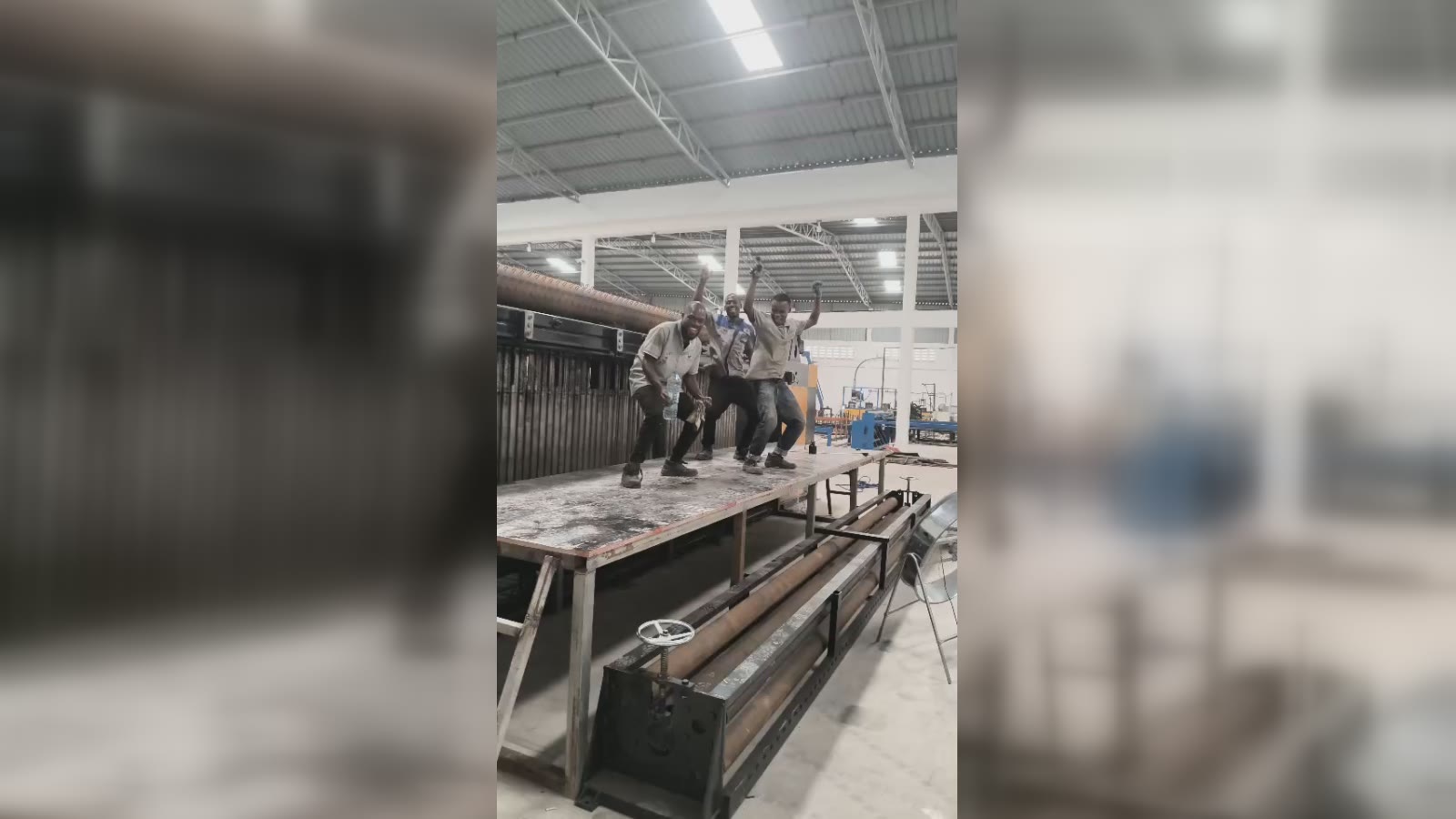
The crate is open. The machine is levelled, wired and threaded. Mesh is coming off it. And the workshop team is standing on the machine, celebrating.
This is the end of commissioning week at a factory in Ethiopia.
That afternoon is the deliverable. Not the container, not the machine sitting in the workshop — the point where local operators can run it and the mesh is good. Everything before it is preparation for that moment.
What the days before it look like
Commissioning a CNC gabion mesh weaving machine is not plug-in-and-go. In the order it actually happens:
- Position and level. The machine sits on its frame rather than a bolted foundation, but it has to be level and stable. A machine that rocks will not hold twist consistency, and twist consistency is the product.
- Power and controls. The electrical panel is built for a specific voltage and frequency. This is the point where site supply and machine specification either match, or become a project.
- Thread the wire. From the pay-off stands through the guides, into the warp, through the weaving mechanism. It is the slowest part of the first day and the part everybody underestimates.
- Set the opening. Tooling is changed to the target mesh opening, and the first panels are measured against what was ordered — not against “looks fine”.
- Run, check, adjust. The first rolls are made and used to dial in tension and twist. This is what fills the remaining days.
By the time people are dancing on the machine, all five are done.
What the buyer has to have ready
Most commissioning delays are not machine faults. They are site things that were not ready. Before the crate arrives:
| Ready before delivery | Why it matters |
|---|---|
| Power supply confirmed | Voltage and phase must match the panel. Rebuilding a panel after it ships is expensive and slow. |
| A clear, level floor | With room to bring wire coils in and move finished rolls out, without crossing the line. |
| Wire on site | A machine cannot be set against a target mesh opening using whatever wire happens to arrive later. |
| Operators named | Commissioning is also training. If nobody is assigned, the technician trains whoever walks past, and that knowledge leaves with the day. |
| A written target spec | Mesh opening, wire diameter, working width. The first runs are checked against this. |
The last two are the ones most often skipped, and they are the ones that decide whether the celebration at the end of the week is real.
What “done” actually means
A machine is not commissioned when the technician says it works. It is commissioned when:
- The local operators can thread it, change the tooling and run it without help
- The mesh coming off it meets the opening and twist that were ordered
- Someone on site knows what to do when the wire breaks or the twist drifts
If commissioning ends with the technician still standing at the controls, the machine is installed — not commissioned. Plan for the handover to be explicit: have your own people run the last shifts.
The weeks after
The celebration is one afternoon. Production is years. Three things to settle before the technician leaves:
- Wear parts on the shelf. Twisting heads, shear blades, guide rollers. Ask for the list at order time and have the first set on site before commissioning, not after the first stoppage.
- A maintenance rhythm. Gabion machines are robust but not fit-and-forget. Daily checks and a weekly routine are what keep the twist consistent month after month.
- A contact who answers. When something behaves strangely in month three, you need a person and a channel, not a general inbox.
The short version
Commissioning is a few days of levelling, threading, setting and running. The buyer’s job is to have power, floor space, wire — and above all, the people who will actually run the machine. Do that and the last day looks like the video above.
We install and commission CNC gabion mesh weaving machines on site, and we plan complete lines around your basket sizes and output target. If you are setting up a workshop, send us the mesh openings, wire diameter, working width and monthly target — we will tell you what the machine has to be, and what your site needs to have ready before it arrives.
木箱已经拆开。机器已经找平、接好电、穿好丝,网片正在产出。车间团队站在机器上庆祝。
这是埃塞俄比亚某工厂调试周结束时的样子。
那个下午才是真正的交付成果。不是集装箱,也不是停在车间里的机器——而是当地操作工能独立开动它、网片质量达标的那一刻。在此之前的一切,都是为这一刻做准备。
之前的几天是什么样
给一台 CNC 石笼网编织机 调试,不是插上电就能开工。按实际发生的顺序:
- 就位与找平。 机器安装在机架上,而非浇筑地基上,但必须水平、稳定。一台会晃动的机器无法保持扭结的一致性,而扭结的一致性正是产品本身。
- 电源与控制。 电气控制柜按指定的电压和频率制造。工厂供电与设备规格在这里要么匹配,要么变成一个大工程。
- 穿丝。 钢丝从放线架穿过导丝器、进入经线,再穿过编织机构。这是第一天最慢的一步,也是所有人都低估的一步。
- 定网孔。 更换工装到目标网孔尺寸,用第一批网片对照订单要求逐项测量——而不是凭「看着还行」。
- 试产、检验、调整。 用前几卷网片反复校准张力和扭结。这就是剩下的几天要做的。
等到有人在机器上跳舞的时候,这五步就都完成了。
买家需要提前备好的东西
大多数调试延误都不是机器故障,而是现场该准备的没准备好。木箱到货之前:
| 到货前备好 | 为什么重要 |
|---|---|
| 确认电源 | 电压和相数必须与控制柜匹配。控制柜出厂后再改,又贵又慢。 |
| 平整的空地 | 要留出把钢丝卷运进来、把成品网卷运出去的通道,且不穿行生产线。 |
| 钢丝到位 | 机器要对着目标网孔调试,不能等钢丝后来随便到一批就用。 |
| 指定操作工 | 调试同时也是培训。没人被指定,师傅就培训路过的人,知识当天就散掉了。 |
| 书面目标规格 | 网孔尺寸、钢丝直径、工作幅宽。前几卷网片都要照着它检验。 |
最后两条最容易被漏掉,而正是它们决定了收尾那天的高兴是不是真的。
「装完了」到底指什么
机器不是师傅说「能用」就算调试完成的。真正的完成是指:
- 当地操作工能独立穿丝、换工装、开动机器,不需要人帮;
- 机器产出的网片达到订购的网孔和扭结标准;
- 现场有人知道钢丝断了、扭结跑了该怎么办。
如果调试结束时师傅还站在操作台前,那机器只是「装好了」,不是「调试完了」。要让交接明确:最后几个班次由你自己的人来开。
之后的几周
庆祝只是一个下午,生产是很多年。师傅走之前要敲定三件事:
- 易损件上架。 扭结头、剪切刀片、导丝辊。下单时就要清单,第一套备件在调试前就备在车间里,而不是等第一次停机后再订。
- 保养节奏。 石笼网设备耐用,但不是装完就不用管。日常点检加每周保养,才是让扭结月复一月保持一致的原因。
- 一个找得到的人。 三个月后机器突然不对劲,你需要的是一个渠道和一个人,而不是一个公共邮箱。
一句话总结
调试就是几天找平、穿丝、定孔、试产的过程。买家的任务是提前备好电源、场地、钢丝,以及最重要的——将来真正开机的人。做到这些,收尾那天就是视频里的样子。
我们在现场安装并调试 CNC 石笼网编织机,也围绕您的笼筐规格和产量目标规划整线。如果您正在筹备车间,请告诉我们网孔尺寸、钢丝直径、工作幅宽和月产量目标——我们会告诉您设备该是什么样,以及设备到货前现场要准备好什么。
The crate is open. The machine is levelled, wired and threaded. Mesh is coming off it. And the workshop team is standing on the machine, celebrating.
This is the end of commissioning week at a factory in Ethiopia.
That afternoon is the deliverable. Not the container, not the machine sitting in the workshop — the point where local operators can run it and the mesh is good. Everything before it is preparation for that moment.
What the days before it look like
Commissioning a CNC gabion mesh weaving machine is not plug-in-and-go. In the order it actually happens:
- Position and level. The machine sits on its frame rather than a bolted foundation, but it has to be level and stable. A machine that rocks will not hold twist consistency, and twist consistency is the product.
- Power and controls. The electrical panel is built for a specific voltage and frequency. This is the point where site supply and machine specification either match, or become a project.
- Thread the wire. From the pay-off stands through the guides, into the warp, through the weaving mechanism. It is the slowest part of the first day and the part everybody underestimates.
- Set the opening. Tooling is changed to the target mesh opening, and the first panels are measured against what was ordered — not against “looks fine”.
- Run, check, adjust. The first rolls are made and used to dial in tension and twist. This is what fills the remaining days.
By the time people are dancing on the machine, all five are done.
What the buyer has to have ready
Most commissioning delays are not machine faults. They are site things that were not ready. Before the crate arrives:
| Ready before delivery | Why it matters |
|---|---|
| Power supply confirmed | Voltage and phase must match the panel. Rebuilding a panel after it ships is expensive and slow. |
| A clear, level floor | With room to bring wire coils in and move finished rolls out, without crossing the line. |
| Wire on site | A machine cannot be set against a target mesh opening using whatever wire happens to arrive later. |
| Operators named | Commissioning is also training. If nobody is assigned, the technician trains whoever walks past, and that knowledge leaves with the day. |
| A written target spec | Mesh opening, wire diameter, working width. The first runs are checked against this. |
The last two are the ones most often skipped, and they are the ones that decide whether the celebration at the end of the week is real.
What “done” actually means
A machine is not commissioned when the technician says it works. It is commissioned when:
- The local operators can thread it, change the tooling and run it without help
- The mesh coming off it meets the opening and twist that were ordered
- Someone on site knows what to do when the wire breaks or the twist drifts
If commissioning ends with the technician still standing at the controls, the machine is installed — not commissioned. Plan for the handover to be explicit: have your own people run the last shifts.
The weeks after
The celebration is one afternoon. Production is years. Three things to settle before the technician leaves:
- Wear parts on the shelf. Twisting heads, shear blades, guide rollers. Ask for the list at order time and have the first set on site before commissioning, not after the first stoppage.
- A maintenance rhythm. Gabion machines are robust but not fit-and-forget. Daily checks and a weekly routine are what keep the twist consistent month after month.
- A contact who answers. When something behaves strangely in month three, you need a person and a channel, not a general inbox.
The short version
Commissioning is a few days of levelling, threading, setting and running. The buyer’s job is to have power, floor space, wire — and above all, the people who will actually run the machine. Do that and the last day looks like the video above.
We install and commission CNC gabion mesh weaving machines on site, and we plan complete lines around your basket sizes and output target. If you are setting up a workshop, send us the mesh openings, wire diameter, working width and monthly target — we will tell you what the machine has to be, and what your site needs to have ready before it arrives.
Working on a specification?
Send us the mesh opening, wire diameter, working width and the monthly output you are targeting. We will tell you what the machine needs to be — including when the answer is a smaller machine than you expected.